The NHR Soft Open Source Philosophy: Less, but Better
NHR Soft’s open source philosophy focuses on fewer releases, higher quality, production validation, and practical tools that developers can trust long term.
Published
July 12, 2026
Reading Time
3 min read
Article Size
506+ words
Social Tags
Share This Article
Article Overview
This article is part of the NHR Soft knowledge base and is structured to help readers understand the topic quickly, review practical steps, and share product or engineering insights with confidence.
There's a lot of noise in open source. Every week, hundreds of new tools get pushed to GitHub. Most of them solve a real problem for someone, but few of them survive long enough to become truly reliable. We've been thinking a lot about what it means to build open source software that endures.
Our Standard: Ship When It's Ready
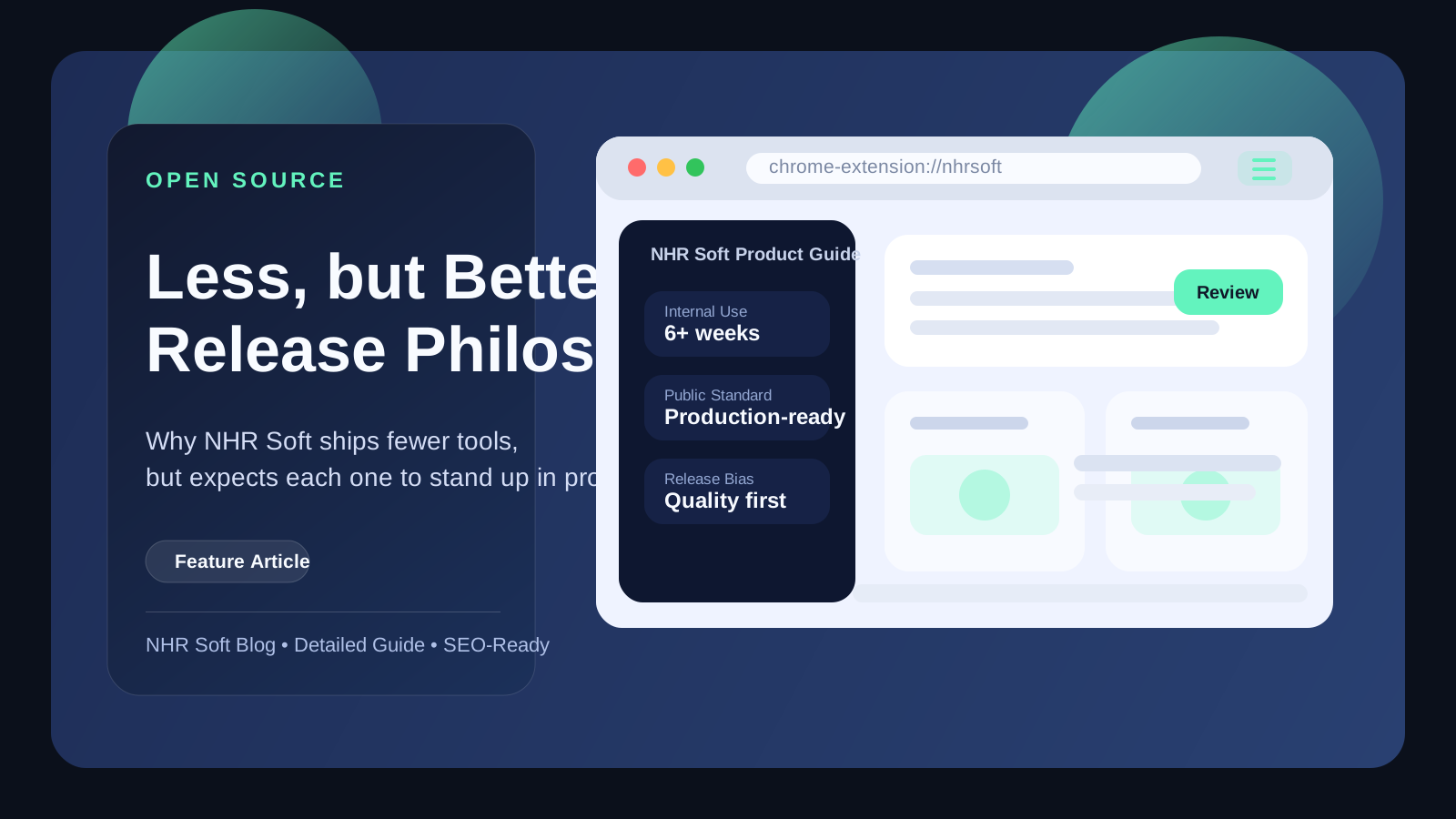
We don't release something until we've used it ourselves, in production, for at least six weeks. This sounds obvious, but it's a discipline. The temptation to ship early and iterate publicly is strong — but for tools that developers put in their critical paths, reliability matters more than novelty.
What We're Opening in 2025
This year, we're planning three open source releases:
- nhr-capture — The platform-native capture core from Snapshot, abstracted as a Rust crate. Screen capture, region selection, and CDN upload, packaged for embedding in your own tools.
- wasm-doc-pipeline — The document processing pipeline from our Chrome Extension. Extract structured content from web pages, convert to Markdown or JSON, pipeline-composable via WASM.
- precision-ui — Our internal component system, designed for dark-themed developer tools. Not another general-purpose design system — this is opinionated, minimal, and production-hardened.
Why We're Not Moving Fast
We've seen what happens when studios push out too many low-quality releases chasing GitHub stars. The stars come and go. What remains is the reputation of the work.
"Less, but better." — Dieter Rams, whose design philosophy we borrow freely.
Every release we make should be something we'd be proud to see used in production by a thousand developers. If it doesn't clear that bar, it stays internal until it does.
Follow our GitHub for early access and contribution opportunities when these ship later this year.
What quality means to us
For us, quality is not just passing tests. It means a project has clear documentation, a realistic maintenance path, sensible defaults, and enough internal usage that we understand where it breaks. Too many repositories launch with an attractive README but no operational discipline. That creates excitement for a week and frustration for a year.
How we decide whether something should be public
- The tool must solve a repeated real-world problem for our own team or clients.
- The setup experience must be understandable without internal tribal knowledge.
- The maintenance burden must be realistic for the next twelve months.
- We must be comfortable supporting issue reports without apologizing for basic instability.
Why this matters for search and trust
Users who discover NHR Soft through Google, GitHub, or product comparisons often want evidence that our engineering standards are deliberate. A clear open source philosophy supports SEO, but more importantly it supports credibility. It tells visitors that we value durability over noise and that we publish tools because they are useful, not because we want another launch post.
FAQ
Why not release internal utilities immediately?
Because a tool that is only “interesting” is not enough. It should also be dependable.
Do we reject community contribution?
No. We welcome it. We simply want the base project to be stable enough that contributions build on strong foundations.
Public Discussion
Name and Comment
Share your thoughts on this article. Your name and comment will be published right away on the page.
Published Comments
0
Start the conversation
No comments yet. Be the first person to leave a public note on this article.