How AI Fits Into Our Development Workflow (And Where It Doesn't)
A practical NHR Soft guide to using AI in software development: where it accelerates delivery, where human review is mandatory, and how we keep output trustworthy.
Published
June 28, 2026
Reading Time
3 min read
Article Size
526+ words
Social Tags
Share This Article
Article Overview
This article is part of the NHR Soft knowledge base and is structured to help readers understand the topic quickly, review practical steps, and share product or engineering insights with confidence.
AI coding tools have gone from novelty to table stakes in twelve months. If you're not using them, you're making a deliberate choice to move slower. But using them without thinking carefully about where they fit — and where they don't — creates a different kind of problem: code that looks reasonable but has subtle errors that are hard to catch in review.
Where AI Saves Us Real Time
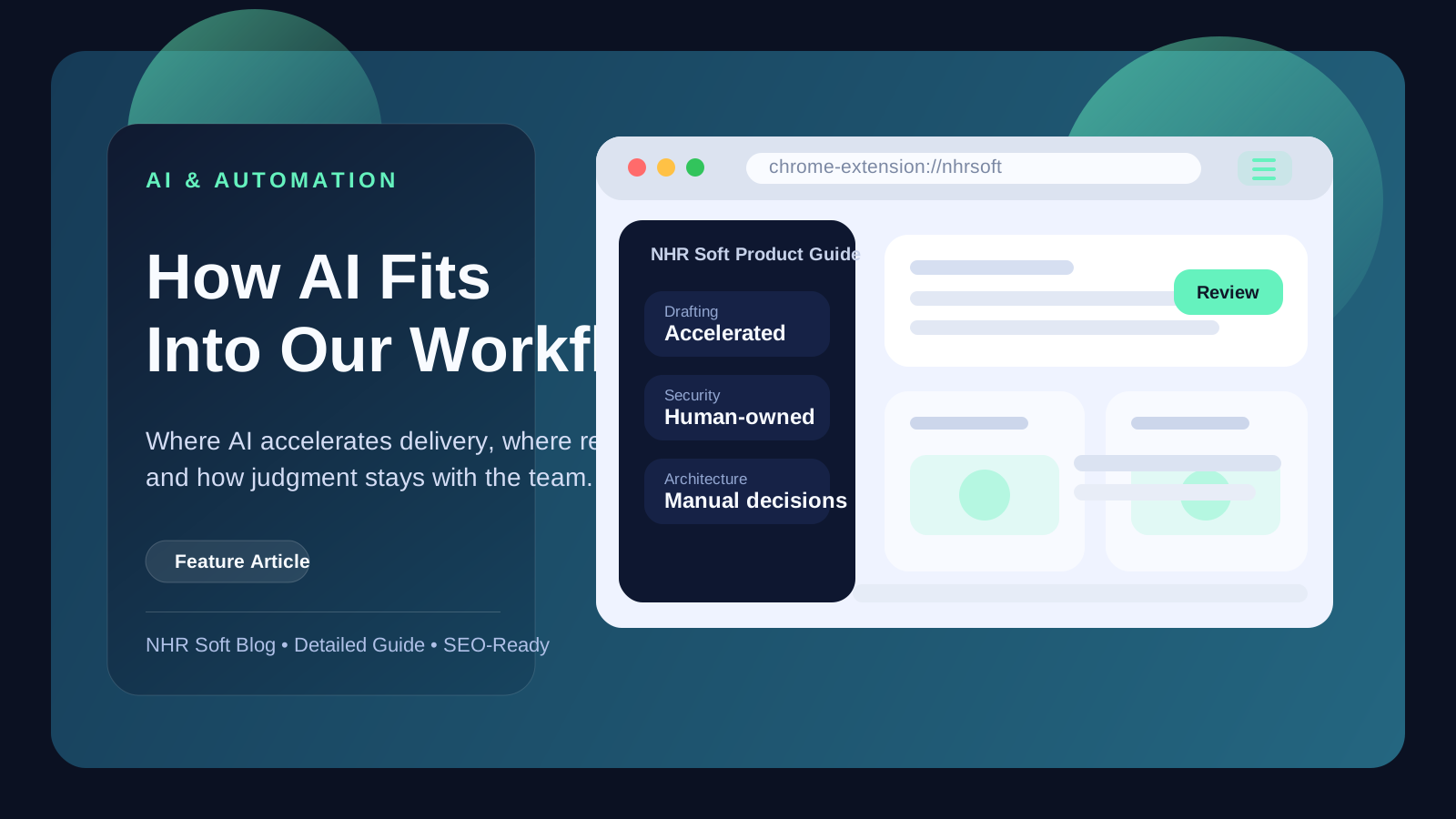
The highest-value use case we've found is boilerplate generation with human review. Writing a new API endpoint, scaffolding a Rust struct, generating test fixtures — these tasks are mechanical and error-prone when done manually. AI handles them faster than we can type and we review the output rather than write it from scratch.
Documentation is the second big win. Our technical writers use AI to generate first drafts from code comments and PR descriptions. The drafts are never publication-ready, but they eliminate the blank-page problem.
Where We Stay Manual
Three areas where we've decided AI assistance does more harm than good:
- Security-sensitive code — Authentication, cryptography, and permission systems. The risk of a confident-but-wrong AI-generated implementation is too high.
- Core architecture decisions — AI is good at tactics, not strategy. System design requires understanding constraints that aren't in the prompt.
- Performance-critical paths — AI doesn't intuitively understand cache behaviour, branch prediction, or SIMD opportunities. It generates correct-looking code that is often not optimal.
The most dangerous AI output is not the obviously wrong answer — it's the plausible wrong answer that passes code review.
Our Toolchain
We currently use a combination of tools depending on context: AI assistants for in-editor suggestions, larger models for architecture discussions and PR review summarisation, and a custom-built prompt library for repetitive codegen tasks specific to our stack.
The key principle: AI is a multiplier on developer capability, not a replacement for developer judgment. Treat its output like you'd treat code from a very fast, very confident junior developer — valuable, but always verify.
Our review rule for AI-assisted work
We never treat AI output as “already done.” Every generated draft must be reviewed by someone who understands the problem deeply enough to reject it. That sounds simple, but it changes behavior. It means prompts are part of the process, not the result. The result is tested, verified code or documentation that a human is comfortable owning.
Where AI helps outside coding
- Summarizing long issue threads into clear action items
- Turning rough implementation notes into first-draft documentation
- Generating alternative naming and copy options for UI review
- Creating structured checklists for QA or release preparation
How we keep AI usage SEO-friendly and audience-safe
When we publish about AI, we want the article to be useful to readers searching for AI development workflow, AI coding review process, or how software teams use AI safely. That means being concrete. Broad claims without boundaries are not helpful. Detailed policies, examples, and exceptions are what make the guidance credible for both users and search engines.
FAQ
Do we let AI ship code directly to production?
No. Generated output always passes through our normal engineering review and release process.
What is the biggest productivity gain?
Draft acceleration on repetitive work, especially scaffolding, summaries, and supporting documentation.
Public Discussion
Name and Comment
Share your thoughts on this article. Your name and comment will be published right away on the page.
Published Comments
0
Start the conversation
No comments yet. Be the first person to leave a public note on this article.