From AI Copilots to AI Agents: What SaaS Builders Need to Design Next
The word "agent" is now attached to almost every AI feature. That makes it important to define the promise clearly. A copilot helps a person perform a task: it...
Published
August 10, 2026
Reading Time
7 min read
Article Size
1,141+ words
Social Tags
Share This Article
Article Overview
This article is part of the NHR Soft knowledge base and is structured to help readers understand the topic quickly, review practical steps, and share product or engineering insights with confidence.
The difference is a product promise, not a label
The word "agent" is now attached to almost every AI feature. That makes it important to define the promise clearly. A copilot helps a person perform a task: it drafts, suggests, summarizes, or explains. An agent is allowed to carry out part of the task through tools and a sequence of actions.
That difference changes the product. A writing assistant can produce a draft and wait. An accounts-reconciliation agent may need to read records, compare transactions, flag exceptions, prepare a report, and ask an authorized person before it posts an adjustment. The second system needs more than a good model. It needs permissions, state, checkpoints, logs, and a safe stopping condition.
Why agents are becoming practical now
Several platform changes are arriving at the same time. Modern model APIs can call tools, search approved data, work through multiple steps, and produce structured output. Open protocols such as the Model Context Protocol are standardizing how AI applications connect to data and tools. Agent-to-agent protocols are also emerging to help separate systems coordinate.
These developments reduce integration work, but they do not remove product responsibility. A protocol can make a connection easier; it cannot decide whether a customer should trust the connection. The quality of an agent still depends on the workflow, the data, the tool contract, and the controls around every important action.
Start with one bounded job
The strongest first agent is rarely a universal digital employee. It is usually a narrow worker with a measurable finish line. Good starting tasks share several characteristics:
- The input and expected output are clear.
- The workflow already exists and can be mapped step by step.
- Errors can be detected before they create irreversible damage.
- A human can review important actions without reviewing every minor calculation.
- The outcome has measurable business value, such as time saved, cases resolved, or documents processed.
Examples include preparing a weekly KPI pack, classifying incoming support requests, extracting structured fields from invoices, checking a product catalogue for missing information, or drafting a response from approved company knowledge. "Run the whole company" is not a useful first specification.
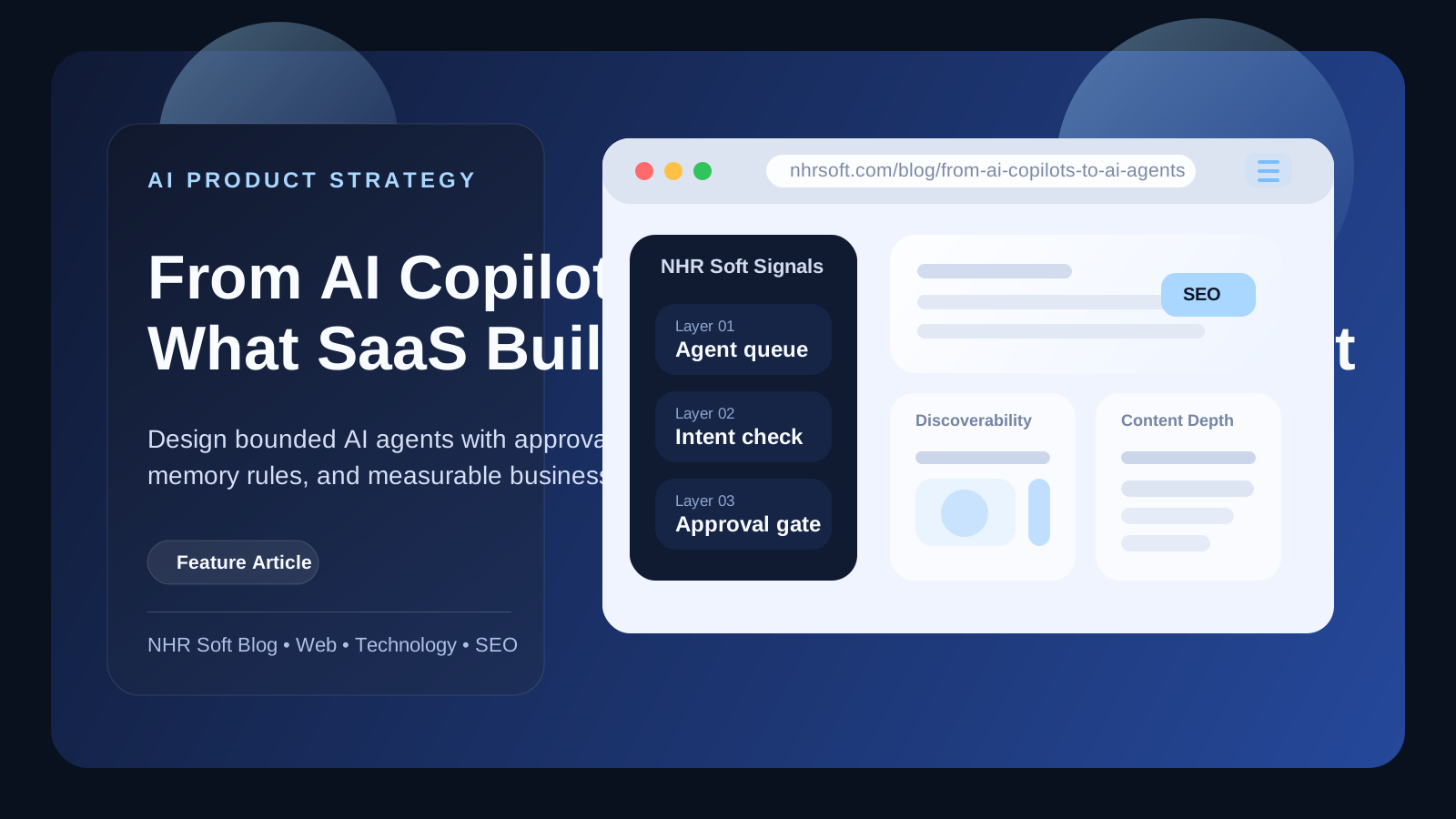
Design six control layers around the model
A dependable agent can be understood as six connected layers.
1. Intent and task boundary
The system should translate a request into an explicit job: what is in scope, what is out of scope, what data may be used, and what counts as completion. Ambiguous requests should trigger a question or a safe default rather than an imaginative guess.
2. Planning and policy
The model can propose steps, but product rules should constrain the plan. For example, the agent may read inventory and prepare a purchase recommendation, but it may not create a purchase order above a threshold without approval.
3. Tool gateway
Every tool should have a narrow contract, typed inputs, validation, and an authorization check. "Database access" is too broad. Prefer tools such as "read stock for warehouse A," "create draft purchase order," and "submit approved purchase order." This makes permissions understandable and limits the damage from a bad step.
4. State and memory
Agents need task state, but not unlimited memory. Store the information required to complete and audit the job. Separate temporary working context from customer records, long-term preferences, and regulated data. Give users a way to inspect or delete retained information where appropriate.
5. Approval and exception handling
Human approval should appear before consequential actions, not after them. The review screen should show the proposed action, the evidence used, the expected effect, and an easy way to edit, reject, or approve. Repeated approvals can later be converted into policy rules, but only after the organization understands the pattern.
6. Observability and recovery
A production agent needs traces, tool results, failure categories, cost data, and quality evaluations. It also needs a recovery path. If a tool fails halfway through a task, the agent should know whether to retry, roll back, save a draft, or hand the case to a person.
Measure completed work, not impressive conversation
Chat quality is not enough. An agent should be measured against the workflow it is meant to improve. Useful metrics include:
- Successful completion rate without unsafe shortcuts.
- Human correction rate and the types of corrections made.
- Time from request to approved result.
- Cost per completed task.
- Escalation rate and recovery success.
- Customer trust signals, such as approval acceptance and repeat use.
This measurement also informs pricing. A copilot may fit per-seat pricing because it helps each user. An agent may be better aligned with documents processed, cases completed, or a hybrid plan with included usage. The value metric should follow the work delivered, not the novelty of the model.
A practical opportunity for NHR Soft products
NHR Soft already works across browser tools and industry-focused systems. That creates opportunities for controlled agents that sit inside real workflows rather than floating above them. In an inventory system, an agent could prepare a replenishment proposal and explain the demand signals behind it. In an association system, it could assemble a dues follow-up list without sending messages until a manager approves. In a browser research tool, it could organize user-selected material while keeping source links visible.
A 90-day development path
A focused team can validate an agent without rebuilding the entire product.
- Map one workflow, including exceptions and approval points.
- Define three to five narrow tools with typed inputs and outputs.
- Build a read-only prototype that produces a recommended result.
- Evaluate it on real historical cases and record failure patterns.
- Add one reversible write action behind explicit approval.
- Pilot with a small user group and measure correction, completion, cost, and trust.
- Expand only when the first workflow is reliable and economically sensible.
The winning agent products will not be those that perform the largest demo. They will be the ones customers can safely place inside important work.
Frequently Asked Questions
Does every SaaS product need an AI agent?
No. If a task is infrequent, highly subjective, or difficult to verify, a simpler search, rule, template, or copilot may be better. Agentic execution is valuable when the workflow is repeated, tool-connected, and measurable.
Should an agent be allowed to make changes automatically?
Begin with read-only analysis and draft actions. Add write access gradually, use narrow permissions, and require approval for financial, customer-facing, security-sensitive, or irreversible actions.
What creates defensibility if many companies use the same models?
The moat is usually the workflow design, trusted integrations, domain data model, evaluation set, customer feedback loop, and operational reliability. The model is one component of the product, not the whole product.
Sources and further reading
- OpenAI - New tools for building agents
- Anthropic - Introducing the Model Context Protocol
- Google Developers Blog - Announcing the Agent2Agent Protocol
- NHR Soft - How AI Fits Into Our Development Workflow
Public Discussion
Name and Comment
Share your thoughts on this article. Your name and comment will be published right away on the page.
Published Comments
0
Start the conversation
No comments yet. Be the first person to leave a public note on this article.