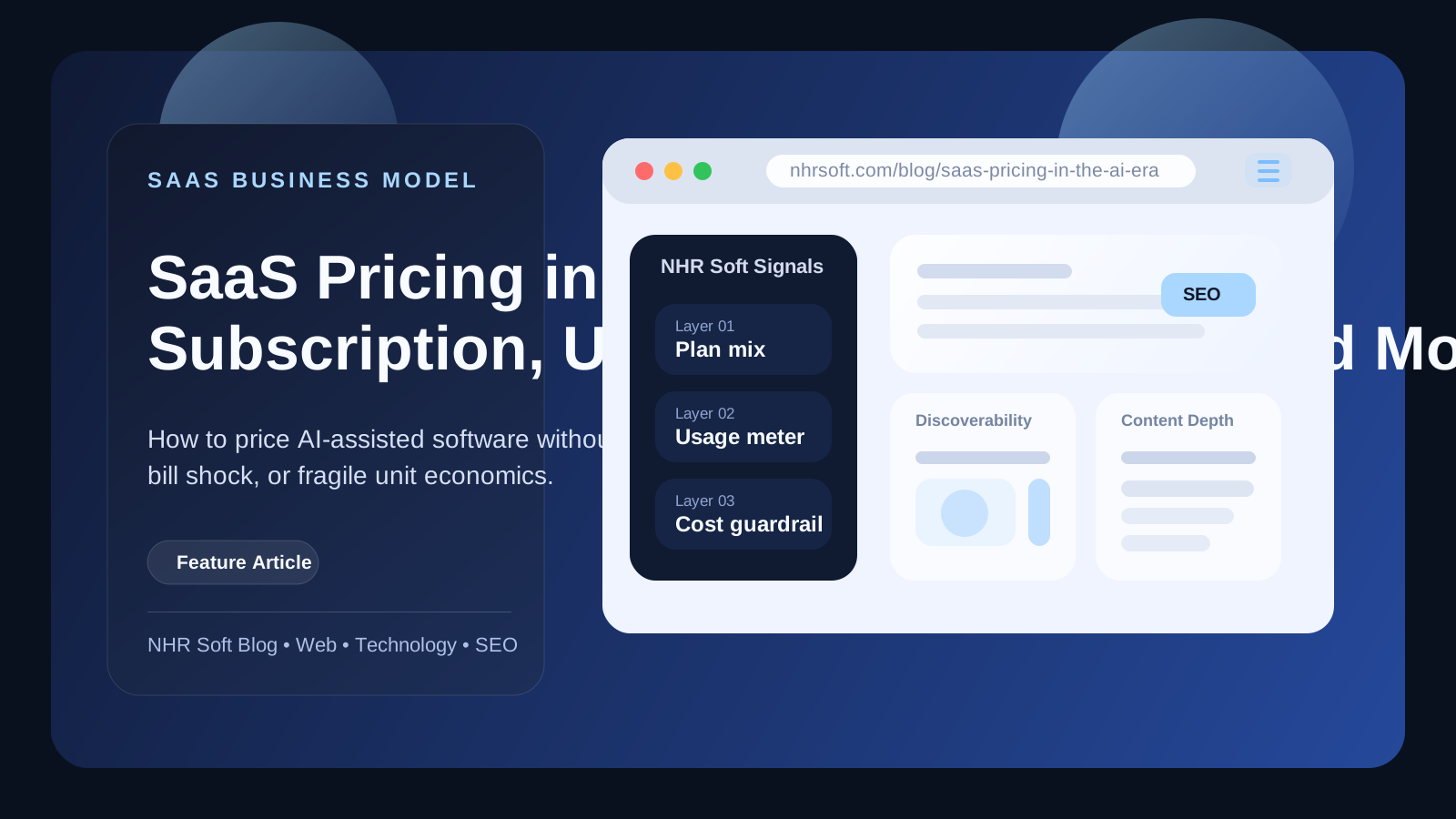
SaaS Pricing in the AI Era: Subscription, Usage, Credits, and Hybrid Models
Traditional software can often serve one more action at very low marginal cost. That made flat subscriptions and per-seat plans convenient. AI features introduce...
Published
August 10, 2026
Reading Time
6 min read
Article Size
1,081+ words
Social Tags
Share This Article
Article Overview
This article is part of the NHR Soft knowledge base and is structured to help readers understand the topic quickly, review practical steps, and share product or engineering insights with confidence.
AI breaks one of the comfortable assumptions of SaaS
Traditional software can often serve one more action at very low marginal cost. That made flat subscriptions and per-seat plans convenient. AI features introduce variable costs for inference, retrieval, tools, storage, and sometimes human review. A power user can cost much more to serve than a light user on the same seat.
At the same time, charging customers for raw tokens or internal compute units can be confusing. Users understand documents, reports, minutes, images, cases, or completed tasks more easily than model accounting.
The pricing challenge is therefore to align three things: customer value, customer predictability, and provider cost.
Understand the main pricing models
Flat subscription
The customer pays a fixed amount for a plan. This is easy to buy and forecast. It works when usage is relatively consistent or when the AI feature has a strict fair-use limit. The risk is that heavy usage compresses margins while light users subsidize power users.
Per seat
The customer pays for each user. This remains sensible when value grows mainly through team adoption, permissions, collaboration, and administration. It is weaker when one user can generate thousands of expensive outputs.
Usage based
The customer pays per document, minute, request, record, or another consumption unit. This aligns revenue with activity and protects the provider, but it can create bill anxiety and slow adoption if users cannot predict cost.
Credits
The plan includes a number of credits consumed by different AI actions. Credits can hide complex model costs behind one understandable balance, but only if the conversion is transparent. A customer should know why one task consumes more credits than another.
Outcome based
The customer pays for a verified result, such as a resolved case, qualified lead, processed claim, or approved document. This can align strongly with value, especially in vertical AI. It requires clean attribution, clear quality standards, and agreement about what counts as success.
Hybrid
A base subscription includes users, platform access, support, and a defined amount of usage. Additional consumption is purchased through overage, top-up, or a higher tier. This gives the customer a predictable floor and gives the provider protection as usage grows.
Choose the value metric before the price
A price is difficult to defend when the charging unit feels unrelated to the benefit. Start with the value metric: the unit that increases when the customer receives more value.
Examples include documents processed, active locations, monitored websites, orders managed, reports generated, minutes transcribed, or successful workflow completions. The best metric is visible, measurable, difficult to manipulate, and reasonably connected to cost.
Avoid charging directly for a technical unit customers cannot plan around unless the product is designed for developers who already understand it.
A practical early-stage pricing structure
Many young SaaS products can start with four clear layers.
- Free or trial: enough capacity to reach a real result, not only view a demo screen.
- Individual or Pro: core features, a predictable monthly allowance, and optional top-ups.
- Team or Business: multiple users, shared workspaces, administration, larger included usage, and reporting.
- Enterprise: security, data controls, service commitments, custom limits, procurement support, and negotiated usage.
Keep the first version simple. It is easier to add a larger plan than to repair a pricing page full of overlapping limits.
Build a cost model before offering "unlimited"
For each chargeable action, estimate:
- Model and tool cost.
- Retrieval, storage, and bandwidth.
- Payment and infrastructure fees.
- Human support or review.
- Failed and retried requests.
- Abuse, free-tier usage, and promotional credits.
A basic contribution calculation is:
Revenue per account - variable delivery cost - directly attributable support cost = contribution before fixed operating expenses.
Model this at typical, heavy, and extreme usage. An unlimited plan may be safe for a local calculator and dangerous for a cloud video or agent product.
Protect customers from bill shock
Usage pricing fails when the customer is surprised. Good product design includes:
- A visible usage meter in the user's language.
- Alerts at selected thresholds.
- Hard caps or approval before paid overage.
- A clear explanation of what consumes capacity.
- Historical usage and a simple forecast.
- Workspace-level budgets and administrator controls.
- Graceful degradation when a limit is reached.
Predictability is a feature. It can be more important than the lowest headline price.
Pricing browser extensions and plugins
Extensions often begin free because installation is a large trust decision and users expect immediate value. Paid plans work best when they add durable benefits rather than remove the core function after installation.
Possible paid value includes cross-device sync, larger history, advanced exports, team libraries, managed AI, batch processing, collaboration, organization policies, and priority support. A one-time purchase can fit a stable, local utility, but it may not support ongoing cloud or AI cost. A subscription should be tied to continuing service, not used only because SaaS pricing is fashionable.
How NHR Soft can apply the framework
NHR Soft has products with very different economics. A local alarm or calculator can remain free or use a simple one-time upgrade because the delivery cost is low. A research, summarization, monitoring, or AI workflow product may need included usage and a paid capacity model. Industry systems may combine implementation, monthly platform access, users or locations, and transaction or AI usage.
Run pricing experiments without confusing customers
Test packaging in small, explainable steps. Interview customers about value units. Show alternative packages before changing production pricing. Track conversion, activation, gross margin, expansion, downgrade, support questions, and usage distribution.
Grandfathering existing customers or giving advance notice can protect trust. Pricing is part of the product relationship, not only a finance decision.
Frequently Asked Questions
Is per-seat pricing dead for AI SaaS?
No. It still works when collaboration, access, and team adoption drive value. It may need an included usage allowance or overage when compute varies significantly by user.
Are credits better than usage billing?
Credits are useful when several AI actions have different internal costs. They become frustrating when the conversion is hidden or changes unpredictably. Explain the unit and show expected consumption before an action.
Should a new product offer a lifetime deal?
Only when long-term delivery costs are low and the support commitment is understood. Lifetime access is risky for products that depend on paid APIs, storage, synchronization, or frequent platform maintenance.
Sources and further reading
- Stripe - AI SaaS pricing models: A guide for founders
- Bessemer Venture Partners - The AI pricing and monetization playbook
- Stripe Sessions 2026 - The new economics of SaaS pricing
- NHR Soft - Products
Public Discussion
Name and Comment
Share your thoughts on this article. Your name and comment will be published right away on the page.
Published Comments
0
Start the conversation
No comments yet. Be the first person to leave a public note on this article.